In this article, I want to cover so-called compartments. When talking about decompression theory, especially nitrogen saturation/desaturation, this term is thrown around a lot, and therefore, I want to clarify exactly what it refers to and what compartments represent.
Before getting into it, to get a better understanding, let's first talk about inert gases saturating our bodies during dives: As scuba divers go deeper, the ambient pressure increases, which, in turn, increases the partial pressure of the inspired gases and creates an excess of gas the body is exposed to. Oxygen is metabolized by the body and turned into carbon dioxide, which is then exhaled. However, inert gases (nitrogen being the main one when inhaling air) are not metabolized, and the excess is dissolved throughout the body, stored in our tissues. While the divers are still subjected to a higher ambient pressure, all the dissolved inert gas is able to stay in its dissolved state. However, as the diver ascends, and the ambient pressure diminishes, the dissolved inert gas will attempt to come out of solution: if the diver doesn't allow enough time for the gas to desaturate their tissues, the excess inert gas coming out of solution will form small bubbles and cause decompression illness.
Okay, but what do "compartments" have to do with all of that? Well, scientists noticed that depending on the dive profile, different areas of the body were getting "bent". Additionally, considering the inert gas saturation/desaturation of the body as a whole wasn't accurate enough. For this reason, scientists (specifically, J.S. Haldane, in the early 20th century) considered that the human body was made up of parallel compartments in which nitrogen and other inert gases would diffuse independently. Each of those compartments would have a different rate of saturation and a different tolerance for supersaturation. To this day, multi-compartmental models are the most prominent type of decompression models used.
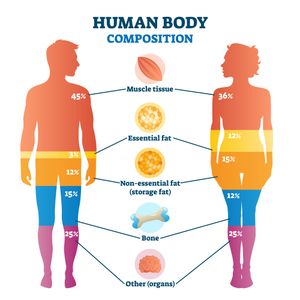
Intuitively, you can think of a compartment as different "areas" in your body, with a higher or lower supply of blood flow. The "faster" compartments (i.e., the compartments that saturate and desaturate faster) have a more prominent supply of blood, meaning the exchange of gas occurs at a higher rate. Conversely, the slower compartments can be imagined as tissues with a reduced blood flow, where gas exchange takes longer. In his book Dekompression - Dekompressionskrankheit (which stands for "Decompression - Decompression sickness") published in 1983, Albert Alois Bühlmann describes the fastest tissues to be the brain and the spinal cord, followed by the skin and muscles, then the inner ear, and finally the joints and bones being the slowest ones. Whether compartments are just mathematical tools used by decompression models or whether they represent real body parts can be debated.
Half-times
Each compartment in our body is associated with a half-time, which represents the time it takes for it to reach 50% of its saturation value: they are the main mathematical tool used to identify specific tissues and to model the inert gas absorption and elimination rate. If we imagine our tissues' perfusion to depend on fitness level, hydration, body fat percentage (and many other factors), it becomes evident that absorption and elimination rate will vary greatly between two divers, or even between the same diver at two different moments (which means half-times will vary as well). However, to simplify the model, modern compartmentalized decompression models (so-called neo-Haldanian models) consider fixed half times: for instance the ZH L-16C decompression model uses 16 different compartments, with half-times ranging from 5 minutes to 635 minutes.
A very important concept to keep in mind when discussing half-times is that a compartment doesn't take 2 half-times to reach 100% of its saturation level. But rather, after 2 half-times, it will be at 75%, then at 87.5%, etc. After each consecutive half-time, it will be at 50% of the value before the previous half-time and the target saturation level. The graphs below represent the inert gas saturation level for a compartment during off-gassing and on-gassing: As you can observe, the saturation level asymptotically approaches the saturation line, without ever reaching it; however, it is common practice to consider a tissue completely saturated after about 6 half-times.
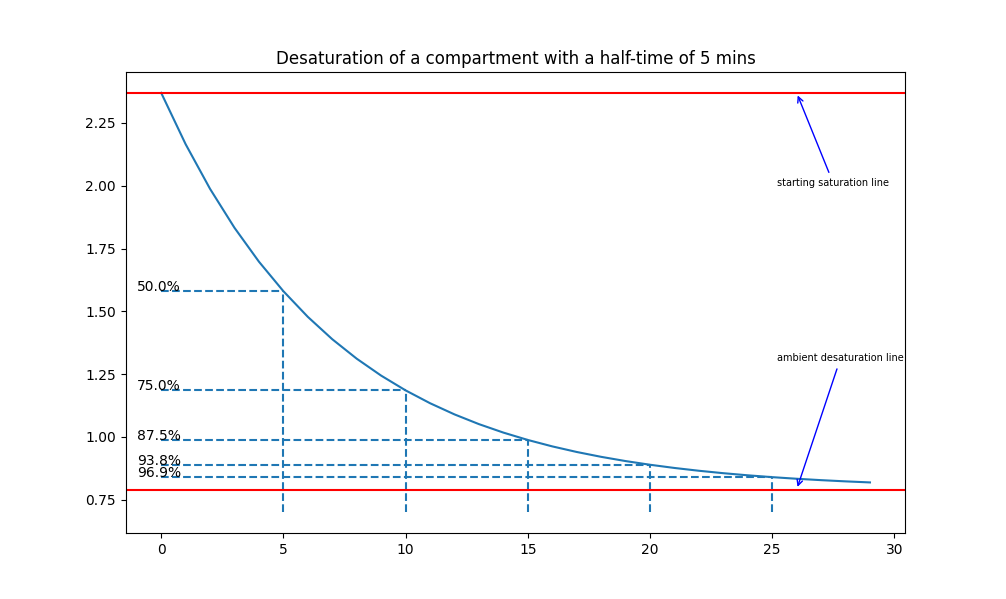
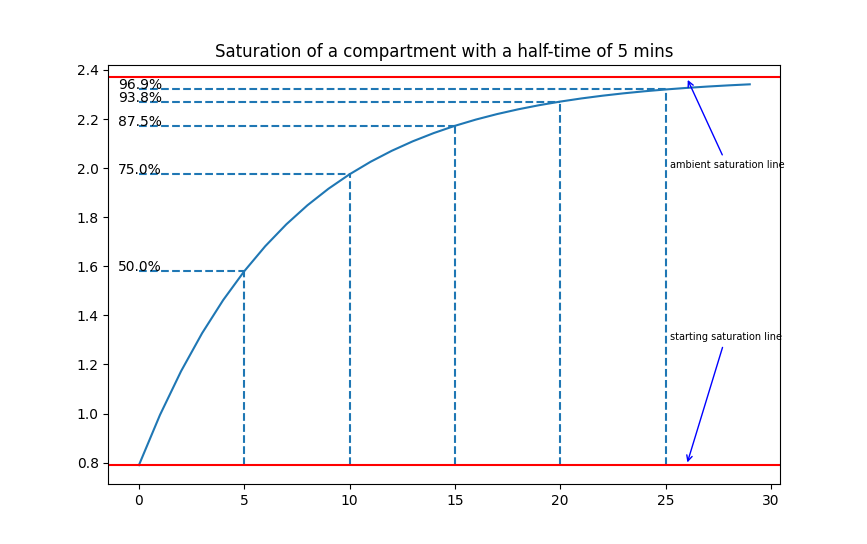
A graph representing the desaturation and saturation of a compartment with a half-time of 5 minutes.
Compartments are considered to be independent during saturation and desaturation. This mean each compartment will have its own amount of dissolved inert gas throughout the dive. Because of this independence and different half-times, it is common to be in a situation where a compartment is saturating while another is desaturating. Decompression models and dive computers simultaneously and constantly check and update the inert gas saturation level of all compartments during a dive.
M-values
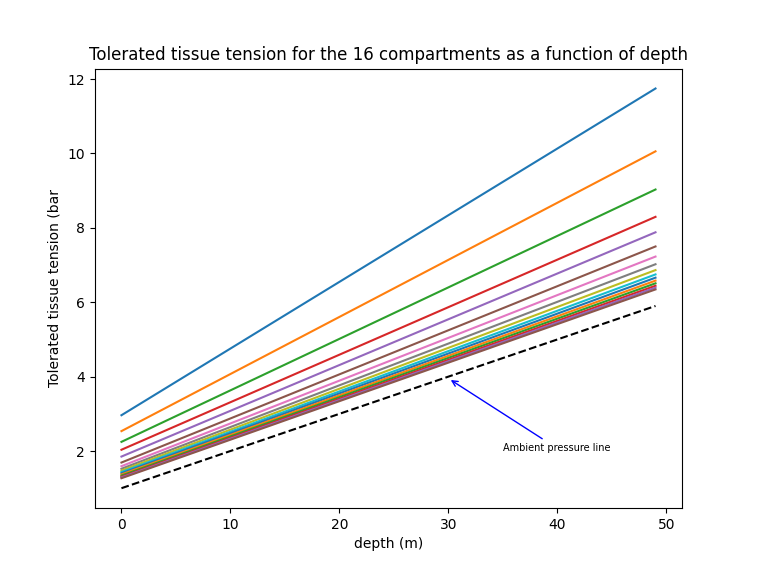
M-values may differ in the way they are called or calculated depending on the decompression model, but fundamentally represent the same thing: the tolerated quantity of inert gas dissolved in the compartments. M-values is the term used in the Bühlman-based decompression models, while the the RGBM (Reduced Gradient Bubbles Model) will consider critial radii of microbubbles, and the Thalmann-based decompression models call it MPTT (Maximum Permissible Tissue Tension). All of those denominations have the same underlying idea: using the calculated dissolved inert gases to know if an ascent is permissible or not (which will then be used to generate decompression stops).
For Bühlmann models, the M-values vary as a function of which compartment is considered: the faster compartments can tolerate a greater supersaturation gradient, while slower compartments have a lower tolerance. As the M-values increase with depth (more inert gas can be dissolved the deeper a diver is), the M-values in the ZH L-C model can be represented as follow, with the higher lines representing the faster tissues (the higher a line is the greater its supersaturation tolerance).
Conclusion
In short, what are compartments? They are a way scientists subdivide our body in multiple parts to track the inert gas that saturates it throughout the dive and quantify what supersaturation level it is able to tolerate while minimally risking decompression sickness.